Manufacturing
Beyond the Blueprint: Why Factory Floor AI Demands Self-Hosted LLMs
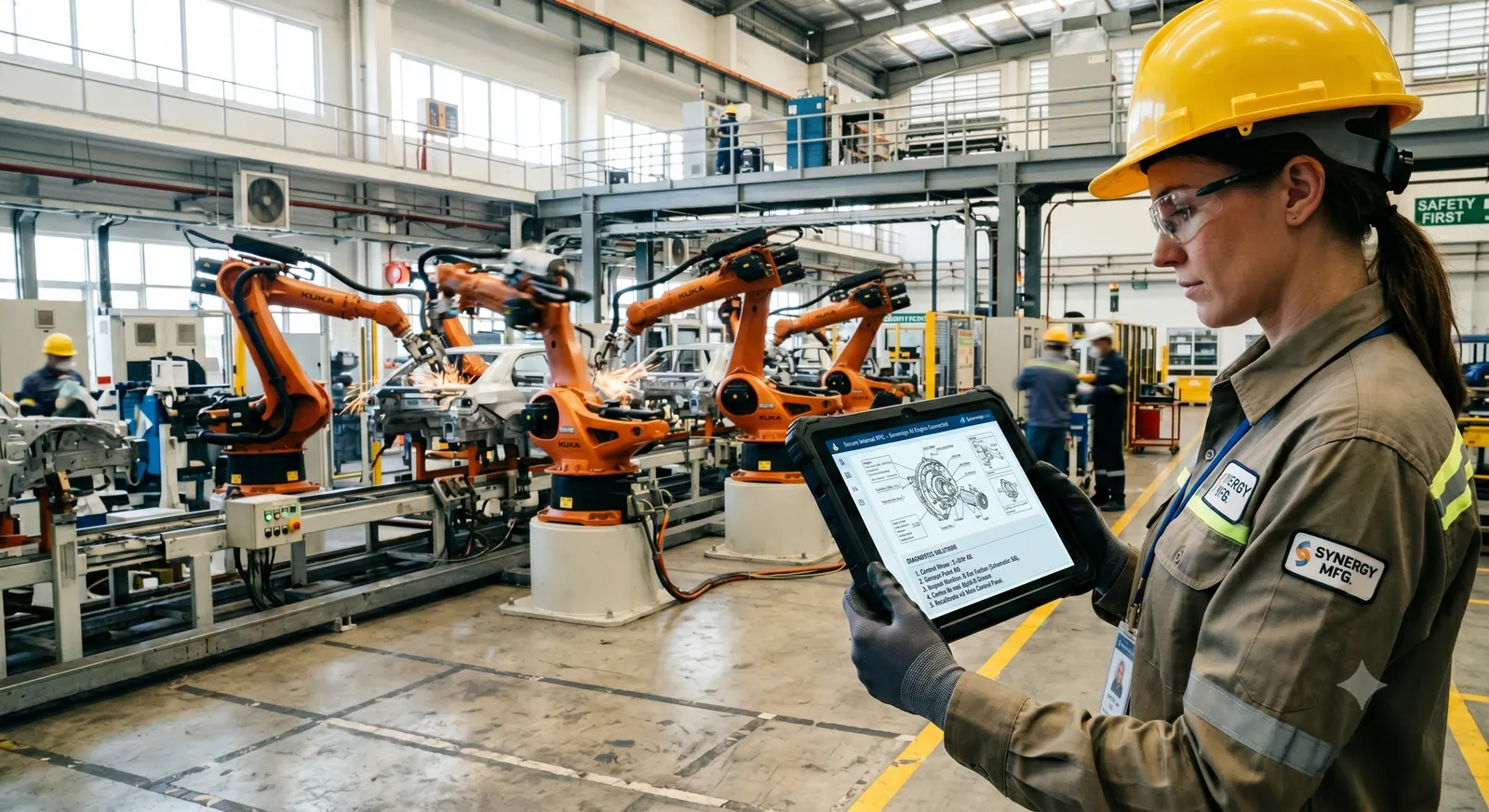 Every second counts on a modern manufacturing floor. When a critical piece of machinery flashes a cryptic error code on the line, the cost of unplanned downtime isn’t measured in hours, it’s measured in thousands of dollars per minute.
To fix the issue, maintenance technicians have historically had to dig through massive, dense libraries of legacy PDF manuals, historic repair logs, and fragmented schematics. It’s a slow, manual process that eats away at operational efficiency.
To accelerate this process, many industrial enterprises are looking toward generative AI and Retrieval-Augmented Generation (RAG) to build smart Maintenance, Repair, and Operations (MRO) assistants that instantly synthesize these technical documents into clear, step-by-step diagnostic answers.
Here is a look at the challenges of scaling factory-floor AI, and why a Bring-Your-Own-Cloud (BYOC) self-hosted approach offers a more resilient path for heavy industry.
The Production Challenge: Scale, Latency, and Precision
Moving from a basic documentation search to an intelligent, interactive assistant changes how your underlying data infrastructure behaves. Heavy industrial environments introduce three strict operational requirements: Latency, Throughput, and Data Privacy.
- Overcoming Domain Blindness Safely
A generic, out-of-the-box model lacks the precision required for specialized manufacturing workflows. It does not natively understand your facility's custom machine configurations, localized shorthand, or proprietary part numbers.
To close this gap, the AI model must either be fed extensive documentation via RAG or undergo direct fine-tuning. However, uploading proprietary schematics, operational failure data, or custom facility layouts to an external cloud endpoint introduces significant data sovereignty and intellectual property risks.
- Deterministic Latency vs. Shared Cloud Volatility
On a production line, an AI assistant must be fast to be useful. Traditional database queries are low-latency but lack reasoning capabilities. If you route those queries through standard external SaaS APIs, response times can become volatile, frequently averaging more than 20s seconds or spiking during peak public cloud usage hours due to shared network traffic and regional throttling. For a technician troubleshooting an active line failure, unpredicted latency translates directly into extended downtime.
- Managing Spiky Throughput
Industrial workflows are naturally uneven. If a primary sub-system triggers an alert, dozens of technicians across multiple shifts might query the diagnostic assistant simultaneously. Traditional internal servers handle predictable query volumes, while public SaaS platforms enforce rigid rate limits that can throttle concurrent users during operational spikes. A production-grade architecture requires a system capable of handling high concurrency without degrading performance.
The Sovereign AI Alternative: Managed BYOC
To balance high-performance execution with strict data security, industrial companies are adopting a Bring-Your-Own-Cloud (BYOC) model. Rather than moving your data to an external provider's API, the entire language model infrastructure is deployed directly within your own secure Virtual Private Cloud (VPC) across AWS, Google Cloud, Azure, or on-premise Kubernetes clusters.
Traditional Search & SaaS vs. BYOC
| Feature | Traditional Search / SaaS | Managed BYOC |
|---|---|---|
| Cost Structure | Linear scale per query | Predictable, fixed |
| Latency | Variable (up to 10s+) | Optimized & flat |
| Data Perimeter | Leaves local network | Stays inside VPC |
| Domain Accuracy | Generic / High error risk | Tailored fine-tuning |
By hosting a specialized, right-sized model on dedicated, optimized infrastructure inside your parameter, the system transforms operational capabilities:
- Guaranteed Throughput: Implementing dedicated inference frameworks like vLLM or TensorRT-LLM on optimized hardware configurations ensures exceptionally high concurrency and flat, reliable latency.
- Fine-Tuned Precision: The model is securely trained and optimized directly on your historic maintenance logs and engineering text, reducing factual errors and aligning the vocabulary with your exact operational jargon.
- Complete Data Sovereignty: Your sensitive operational logs, blueprints, and compliance trails remain entirely inside your cloud ecosystem, ensuring security and compliance by design.
The Economics of Scale: Capping Your OpEx
Beyond the technical performance advantages, self-hosting changes the financial predictability of enterprise AI projects.
In a standard cloud API setup, costs are highly variable, accumulating linearly with every token processed.
A typical industrial RAG prompt is data-heavy—often requiring an average of 1,500 input tokens (to accommodate instructions
alongside multiple reference paragraphs extracted from manuals) and generating roughly 500 output tokens for a highly detailed, safe troubleshooting response.
When deployed across a large enterprise where hundreds of technicians make multiple detailed queries per hour, variable token costs can become unpredictable. With a managed BYOC framework, that variable curve is flattened into a stable infrastructure cost. For instance, a dedicated hosted instance running a highly optimized smaller model carries a fixed monthly infrastructure cost of approximately $1,100.
The Break-Even Threshold: Financial parity with variable cloud APIs is achieved at roughly 400 LLM calls per hour across the enterprise. For a manufacturing operation with a consistent multi-shift user base executing automated workflows or active floor diagnostics, this threshold is rapidly crossed. Once crossed, your marginal token cost effectively drops to zero, turning an unpredictable operational expense into a stable, capped infrastructure investment.
Accelerating the Path to Production
Building and maintaining high-performance, secure AI infrastructure internally typically requires a large, dedicated MLOps team specializing in hardware optimization and secure network architecture.
At Numid, we handle that operational burden for you. We deliver fully managed, hyperscaler-agnostic LLM deployment kits directly within your corporate VPC. By using modular Infrastructure-as-Code (IaC) blueprints for both fine-tuning and inference serving, we help you transition your technical databases into high-throughput, private AI assistants in weeks rather than months.
Want to evaluate how a secure, high-throughput MRO assistant integrates with your existing cloud constraints?