Manufacturing
From Flags to Fixes: Turning Opaque Telemetry into Action with GenAI Copilots
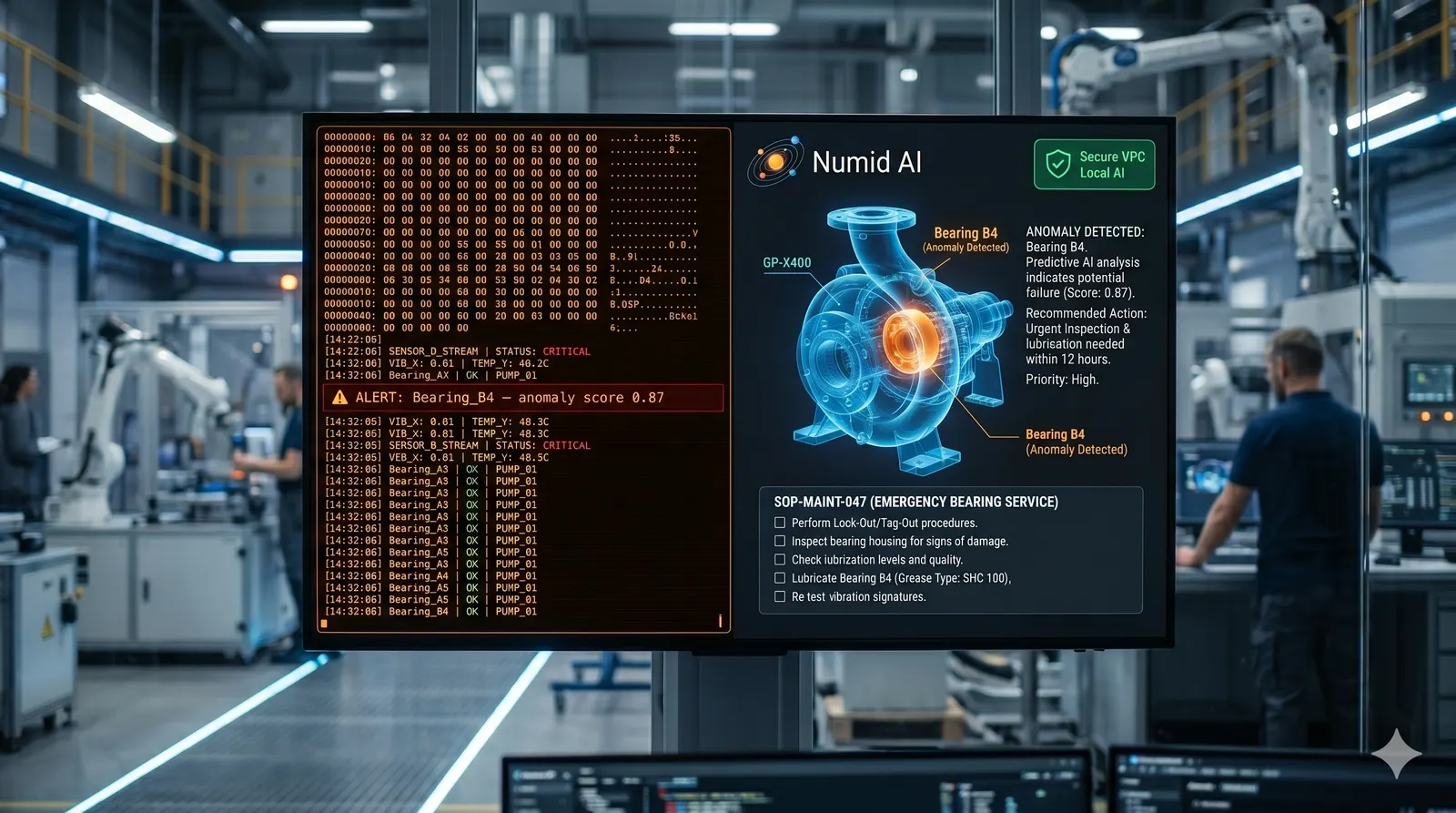
Industrial manufacturing has spent the last decade investing heavily in Predictive Maintenance (PdM). Plants are blanketed with IoT sensors tracking vibration, temperature, and pressure. Advanced data science teams have successfully deployed sophisticated machine learning models to catch asset failures before they cause catastrophic downtime.
Yet, on the actual factory floor, a critical bottleneck remains. Classical predictive models excel at finding anomalies, but they are entirely silent on how to fix them. When a model detects a failure signature, it drops a raw data point into a dashboard, leaving the human operator to bridge the gap between a numeric alert and a mechanical solution.
To solve this operational friction, enterprises are layer-cakeing generative AI copilots directly over their traditional PdM stacks. Here is a step-by-step look at how a generative AI copilot transforms raw industrial telemetry into immediate, targeted action on the production floor.
The Status Quo: What Classical PdM Does
Imagine a critical centrifugal pump operating on a high-throughput chemical production line.
A classical predictive maintenance model such as an Isolation Forest or an LSTM network trained on several months of continuous sensor data detects an irregular waveform. The system triggers a high-priority flag:
ALERT: Bearing_B4 — anomaly score 0.87 — threshold exceeded
That is the extent of the traditional output. It is a number and a flag. For the control room operator or the shift supervisor, the clock is now ticking. They know something is wrong, but they must manually investigate what the number means, look up the asset history, and figure out the correct course of action.
Where the GenAI Copilot Intervenes: Step-by-Step
Our Numid Copilot converts this cold telemetry data into an intelligent workflow by acting as an automated analytical layer between your sensors, your historical databases, and your standard operating procedures.
Step 1: Translating the Signal into Context
The moment the classical alert fires, the copilot automatically ingests the notification along with the last 72 hours of continuous sensor readings (vibration frequencies, temperature gradients, flow rates, and inlet pressures). Simultaneously, it queries your internal maintenance history database using natural language processing.
Instead of an obscure error code, Numid Copilot surfaces a comprehensive summary for the technician:
Bearing B4 on Pump P-112 is showing a 34 Hz sub-synchronous vibration pattern that has increased 18% over the past 6 hours. The same pump had a bearing replacement in March 2023 after a similar signature. Current operating temperature is within normal range, suggesting an early stage race wear rather than lubrication failure.
A classical alert tells you that something is wrong. Our copilot tells you what kind of wrong it is, and exactly why it looks familiar.
Step 2: Extracting the Procedure Without the Search
Knowing the problem is only half the battle, the technician still needs to execute the repair safely and efficiently. Traditionally, an operator has to log into an internal document repository like SharePoint, search for the correct equipment manual, verify the latest version of the Standard Operating Procedure (SOP), and cross-reference tool requirements—a process that introduces 20 to 40 minutes of administrative friction before a wrench is ever picked up.
Numid Copilot bypasses this search friction entirely by automatically querying the localized MRO knowledge base and printing the exact operational directive:
Applicable procedure: SOP-MAINT-047, Section 3.2 — Bearing inspection under live vibration. Required tools: SKF TMBN 10, torque wrench 40–60 Nm. Estimated duration: 2.5h. Line shutdown required: No — procedure can be executed under reduced load (< 60% capacity).
Within seconds of the initial anomaly, the operator knows the exact tools to grab, how long the job will take, and crucially, that they can keep the production line running under a partial load rather than executing a costly, unnecessary emergency shutdown.
The Infrastructure Choice: Why Public APIs Fall Short
Building an agentic copilot capable of synthesizing live telemetry, historical maintenance logs, and proprietary SOPs changes your technical infrastructure demands.
-
Data Sovereignty and IP Risks: Your maintenance logs, asset floor plans, and internal chemical processing workflows represent highly sensitive, proprietary operational data. Routing this data to an external, multi-tenant public cloud API exposes your organization to significant data compliance and intellectual property leakage risks.
-
The Ingestion Token Tax: Agentic loops are text-heavy. Ingesting hours of structured sensor logs combined with dense, multi-page PDF manuals creates large prompt contexts. Under a commercial SaaS model where costs scale linearly with every token processed, running automated diagnostics for thousands of factory alerts can cause your operational expenses to become highly volatile and unpredictable.
-
Performance Stability: When a critical asset risks failing, a technician cannot experience variable latency or rate limits caused by public cloud congestion. Factory applications require localized, deterministic throughput to ensure immediate response times under any operational spike.
Standardizing Your Workflow with Numid AI
To run high-stakes operational copilots safely, industrial enterprises are bypassing public cloud endpoints and deploying dedicated, At Numid, we provide the managed infrastructure, MLOps expertise, and deployment blueprints to run production-grade LLMs inside your own cloud, without the headcount burden. By using modular Infrastructure-as-Code (IaC) blueprints for both fine-tuning and inference serving, we help you deploy private, specialized AI tools in weeks rather than months.