Supply Chain & Logistics
Accelerating Tender Ingestion: Optimizing Freight RFP Analysis via Private AI Infrastructure
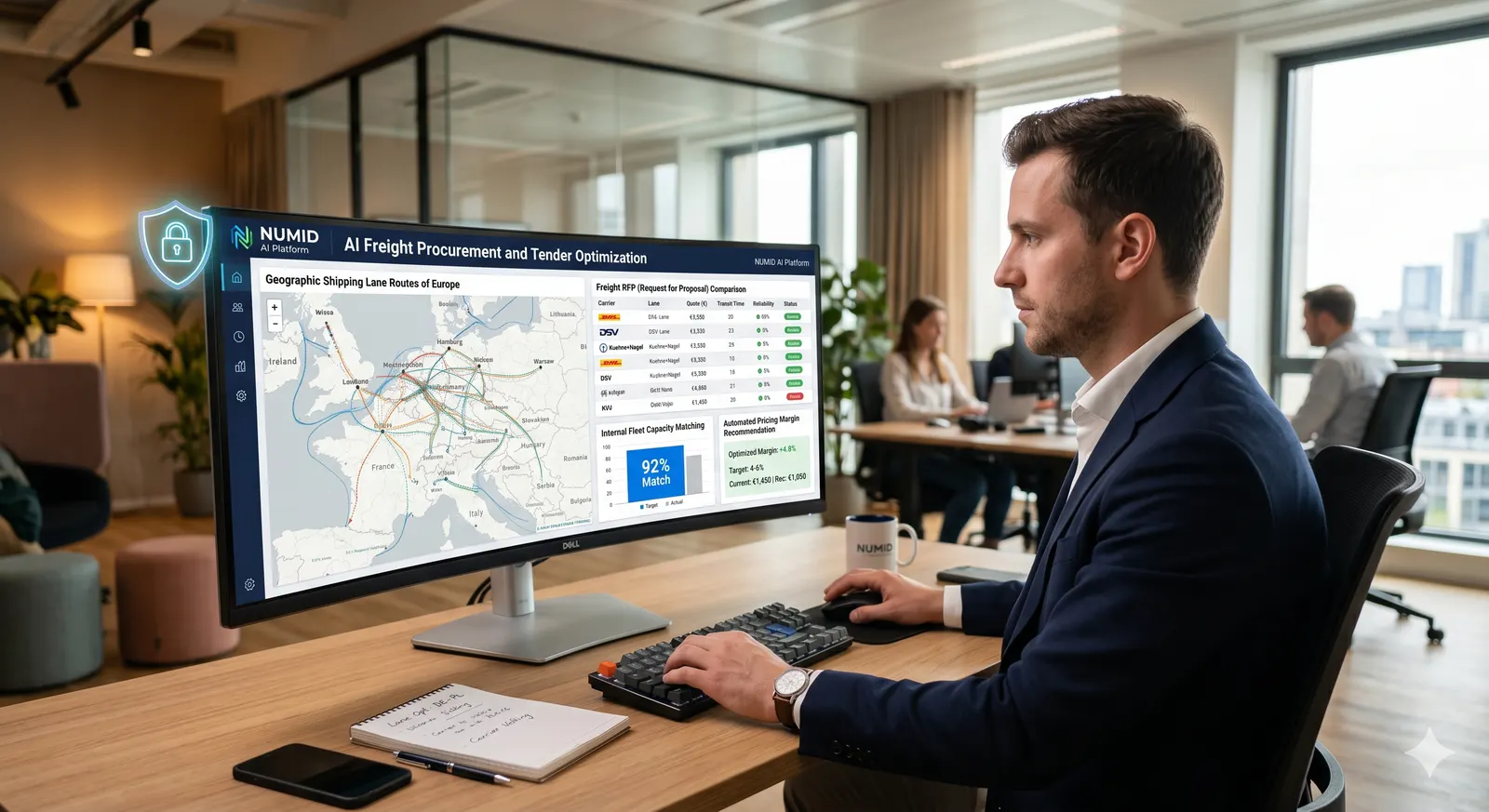
For medium-sized logistics providers and freight forwarders (Speditionen), the arrival of the annual freight tendering season brings intense pressure. Requests for Proposals (RFPs) land on planners' desks as massive, multi-page documents filled with complex legal requirements, shifting lane volumes, strict Key Performance Indicators (KPIs), and detailed carbon reporting mandates.
The operational challenge is a classic trade-off between speed and accuracy. To secure profitable contracts, a provider must respond to these tenders rapidly. However, manually parsing dense spreadsheet matrices and legal text to evaluate lane feasibility can take days of a high-value planner's time. If a bid is rushed, the provider risks miscalculating lane densities or missing strict penalty clauses, potentially locking the enterprise into low-margin or loss-making contracts for the next 12 to 24 months.
To accelerate response times and eliminate manual blind spots, logistics leaders are exploring generative AI to build intelligent tender analysis agents. These agents can ingest, parse, and evaluate complex freight tenders in seconds. However, transitioning these data-heavy procurement workflows into a live production environment requires a careful look at underlying data infrastructure. Scaling these tools efficiently means evaluating the distinct structural trade-offs between public cloud endpoints and dedicated private networks.
Operational Variables: Security, Integration, and Data Heavy Context
Automating a freight RFP review pipeline is far more complex than running standard text summarization. Evaluating commercial transport contracts requires strict alignment across three critical operational pillars: Data Sovereignty, Integration Depth, and Financial Predictability.
-
The Perimeter of Commercial Strategy A freight tender contains highly sensitive commercial data, including exact point-to-point shipping lane networks, volume distributions, and client pricing expectations. When a logistics provider evaluates this data alongside internal historical pricing, capacity limits and margin strategies, data security becomes paramount. Routing these documents through a public, multi-tenant cloud API presents significant intellectual property risks. For a risk-conscious logistics provider, keeping customer data and bidding strategies strictly within the corporate perimeter is a baseline requirement.
-
The Mandate for Domain Precision and Accuracy Evaluating commercial shipping tenders requires an intricate understanding of industry-specific jargon, precise legal clauses, and complex logistics terminology. Generic public models lack this domain-specific precision out of the box, increasing the risk of "hallucinations" where the AI confidently invents or misinterprets critical contract parameters. Achieving production-grade reliability requires a model that has undergone targeted fine-tuning on your proprietary historical bid data, localized contract shorthand, and operational definitions. This tailored optimization stabilizes semantic accuracy, drastically reducing error rates and ensuring the system correctly evaluates complex service level agreements without hallucinating critical operational details.
-
The Context Window "Token Tax" Freight RFPs are inherently text-dense and data-heavy, often featuring extensive lane tables and lengthy service level agreements. Under a standard public cloud API model, costs are highly variable, accumulating linearly with every word processed. Passing massive document contexts back and forth through a public API causes processing fees to scale rapidly, turning a high-volume automated checking loop into an unpredictable and volatile operational expense.
Architectural Balance: The NUMID AI Platform solution
To balance high-throughput document processing with strict data security, logistics enterprises are adopting a Bring-Your-Own-Cloud (BYOC) model. Rather than sending proprietary bidding strategies to an external provider's API, the entire language model infrastructure is deployed directly within the enterprise's secure Virtual Private Cloud (VPC) across any cloud provider.
- Deep Semantic Extraction: The agent reads multi-page PDF tenders to instantly isolate critical contract clauses, minimum volume commitments, fuel surcharge mechanisms, and delivery penalty conditions that standard keyword tools miss.
- Capacity and Fleet Synchronization: Operating directly inside your secure network, the model queries your internal TMS to match requested tender routes against your existing lane density. It automatically flags backhaul opportunities where empty trucks can be utilized, turning open capacity into a competitive advantage.
- Intelligent Margin Recommendation: Instead of just summarizing text, the model acts as a decision support tool. It evaluates historical win rates and real-time fleet costs to generate an optimized target pricing matrix, recommending specific bid points that balance competitiveness with healthy profit margins.
- Absolute Data Control: Your lane networks, customer databases, and pricing algorithms remain entirely within your corporate VPC, ensuring strict compliance with data privacy expectations and corporate risk guidelines by design.
Accelerating the Path to Production
Building and managing high-performance, secure AI infrastructure internally typically requires a large, dedicated MLOps headcount specializing in hardware optimization and VPC architecture[cite: 1, 3].
At Numid, we provide the managed infrastructure, MLOps expertise, and deployment blueprints to run production-grade LLMs inside your own cloud, without the headcount burden. By using modular Infrastructure-as-Code (IaC) blueprints for both fine-tuning and inference serving, we help you deploy private, specialized AI tools in weeks rather than months.